REVIEW · PARIS
Seine River Guided Cruise by Vedettes de Paris
Book on Viator →Operated by Vedettes de Paris · Bookable on Viator
The Seine turns big-name Paris into one easy ride. This 100% electric cruise glides past the Eiffel Tower, Notre-Dame, and the Louvre while a guide adds live narration in English and French. One catch: the sound can be harder to catch from the outdoor upper deck on cold or windy days.
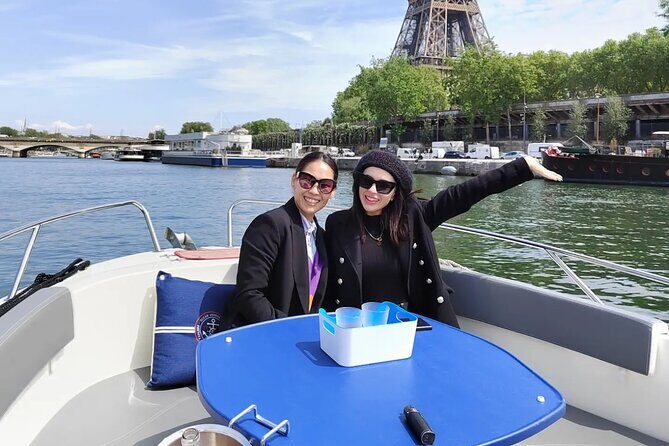
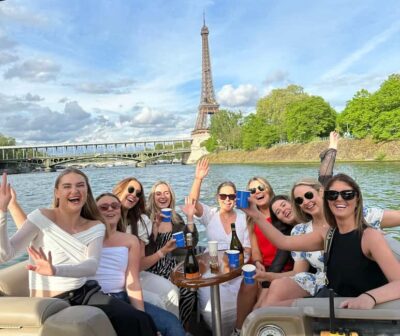
I like that this is short enough to fit into any plan, yet packed with major sights and photo angles. You also get options for a drink-and-snack add-on, including champagne. Just remember you’re on a boat for about an hour, so plan to stand where you can hear best.
Key highlights to know
- 100% electric boat keeps the ride modern and comfortable
- Live English/French guide plus a multilingual audio app on your phone
- One-hour timing is perfect for a first-day orientation
- Optional champagne and snack packages make it feel like a treat
- Not-too-huge boat can mean less crowding than the largest operators
- Outdoor deck views are great, but bring a plan for cold weather and sound
In This Review
- A 1-hour Seine cruise with a modern, quieter feel
- Price and value: what you really pay for around $25.23
- Where to board at Port de Suffren (and how to make it smooth)
- Electric boat comfort: inside seats, outdoor views, and blankets
- The Seine sightseeing stretch: Eiffel Tower to Pont Neuf masks
- Notre-Dame and Île de la Cité: the sacred, the old, and the dramatic
- Île Saint-Louis and the Arab World Institute: quieter Paris along the water
- Hotel de Ville, the Conciergerie, and the Louvre’s full scale
- Place de la Concorde, Grand Palais, and the American Flame
- Palais de Chaillot and Trocadéro views: a strong ending
- Timing tips: how to choose daytime or evening for the best photos
- Small practical gotchas: hearing the guide and using the restroom
- Who should book this Seine cruise (and who might pass)
- Should you book the Seine River Guided Cruise by Vedettes de Paris?
- FAQ
- How long is the Seine River Guided Cruise?
- Is the cruise narration available in English?
- Is the boat electric?
- Are snacks and drinks included in the ticket price?
- Where does the tour start?
- Are toilets free on board?
A 1-hour Seine cruise with a modern, quieter feel
If you only have a day or two in Paris, the Seine is the shortcut to seeing the city’s “greatest hits” without stacking a dozen ticket lines and long walks. This Vedettes de Paris cruise is built around that simple idea: you get a guided glide along the river, with a real person describing what you’re seeing, not just silence and scenery.
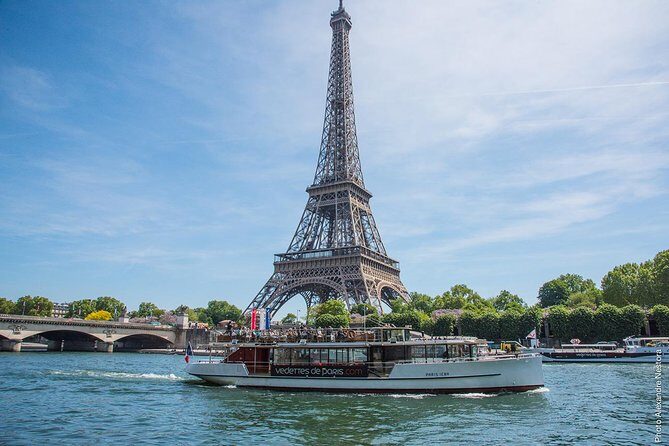
The big practical perk is the 100% electric boat. You still feel the motion and river air, but the overall experience feels more current than the older diesel cruise vibe. The ride is about one hour, long enough to cover a strong stretch of landmarks and short enough that you won’t feel trapped when the weather turns.
I also like the mix of narration formats. You’ll hear a guide in English and French, and you can use a free phone app for commentary in Spanish, Italian, German, and Dutch. That gives you options if the language pacing doesn’t match your ears that day.
Price and value: what you really pay for around $25.23
At about $25.23 per person, this isn’t a “whenever-you-feel-like-it” luxury, but it’s also not trying to be a premium dining cruise. The value is in the ingredients: a guided sightseeing loop, major landmarks visible from the river, and a duration that fits real travel schedules.
Here’s what changes the cost in practice:
- The base ticket includes the cruise and guide narration.
- Food and drinks are only included if you pick a snack or champagne option at booking.
- If you choose the champagne option, it comes with a glass of champagne and is bookable for adults only.
If you’re the type who wants a simple win—see the big monuments, get context, take photos, move on—this price is a good fit. If you want a full-on party with lots of drinks, you’ll need to plan for upgrades or purchases separately.
Other vedettes de paris cruises we've reviewed on the Seine & in Paris

Where to board at Port de Suffren (and how to make it smooth)
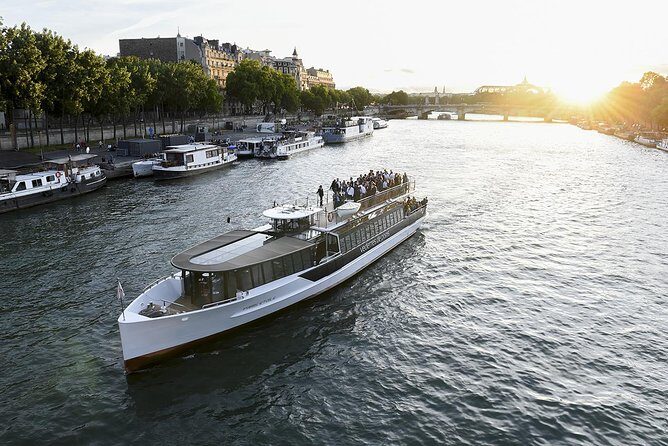
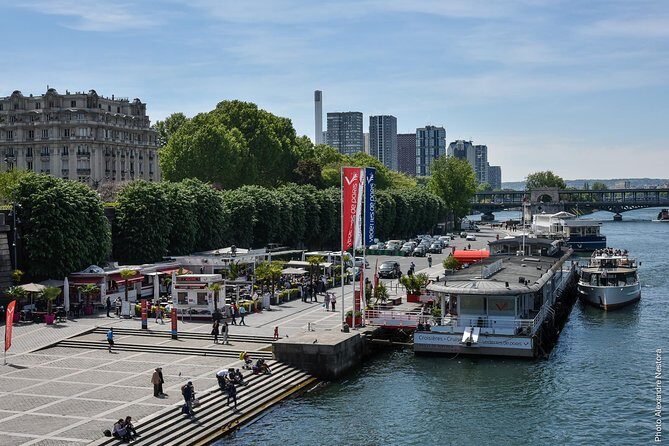
The cruise starts and ends back at the dock near 2 Port de Suffren, 75007 Paris (meeting point: V75R+HJ7). That area is useful because it’s not the most random location in the city—it’s near public transportation, and you’re close enough to central sights that you can chain plans the same day.
Timing matters. The operator runs many departures throughout the day, so you can choose a slot that matches your walking rhythm. My practical advice: arrive a bit early and get settled before the boat pulls away. Even a small delay can make you feel rushed, especially on an open boat where weather can change quickly.
One more logistics detail to take seriously: no baggage accepted on board. If you’re carrying a big backpack, plan to keep it elsewhere before you arrive at the pier.
Electric boat comfort: inside seats, outdoor views, and blankets
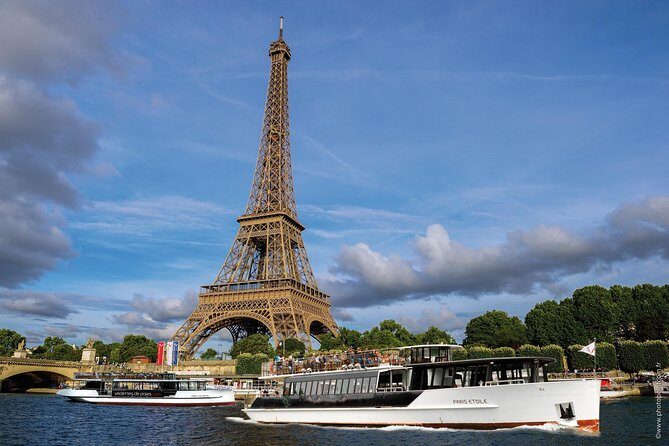
The boat is set up with seating below and an outdoor area on top. That layout is part of the reason the cruise works: you can chase views when the light is good, then retreat indoors when the cold hits.
Sound quality is the tradeoff. A few people find the outdoor deck tougher for hearing the commentary (wind and distance do that). So if you want the history and not just the photos, aim for seats where you can clearly hear the guide. If the sky is gray or the air is cold, it’s smart to sit inside more often than you think.
On colder days, there may be blankets available. That small comfort helps a lot when you’re trying to stay outside long enough to catch bridge views and landmark angles.
The boat also tends not to feel like a giant cattle-car. Several people specifically liked that it was smaller than the biggest ships, and that helped with the overall vibe and boarding speed.
The Seine sightseeing stretch: Eiffel Tower to Pont Neuf masks
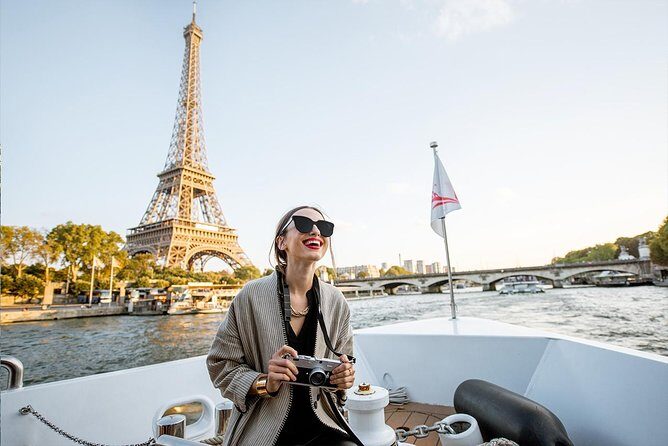
Your cruise starts with the skyline moments that make Paris feel instantly recognizable. As you move along, you’ll pass a sequence of landmarks that range from world-famous icons to impressive bridges and architecture you might otherwise miss.
Eiffel Tower, built to last
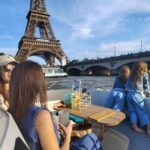
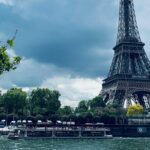
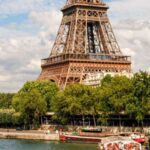
Even when you’ve seen the tower on postcards, the river perspective hits different. You’ll also get a short fact burst: it was built by French engineer Gustave Eiffel for the 1889 Universal Exhibition, and it rose in just over two years. The tower is 324 metres tall, and it was originally planned for a limited era—about 20 years—before keeping its place in the city. A radio antenna added later (in 1903) helped protect it from demolition.
Churches and landmarks with distinct styles
As you continue, the route includes the Holy Trinity Cathedral of the Russian Orthodox tradition, plus the American Church in Paris with its distinctive green clock-tower. These are the kind of spots you can ignore on foot, but from the water they become part of the “Paris puzzle.”
Les Invalides: Napoleon I’s resting place
You also pass Hotel des Invalides, originally ordered by Louis XIV as a military hospital for wounded soldiers and officers. Today, the royal chapel houses the tomb of Napoleon I, which makes the building more than just a pretty mass of stone from the river.
Pont Alexandre III: gold-leaf symbolism
Bridges are where the Seine turns into a photo studio. Pont Alexandre III was built for the 1900 Universal Exhibition and to celebrate the Franco-Russian alliance. Look for the gold-leaf coat of arms and the nymph figures linked to the Seine and the Neva—details that make this bridge feel like a monument in its own right.
Pont de la Concorde: Bastille stones and the National Assembly
Next is Pont de la Concorde, built using stones from the former Bastille prison after the storming in 1789. It leads toward the Palais Bourbon, seat of France’s National Assembly.
Pont Neuf: 381 stone faces
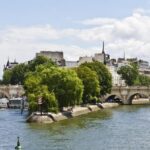
One of the most charming “why don’t I know about this?” moments comes with Pont Neuf, the city’s oldest bridge that was built in stone with pavements rather than housing along it. It’s decorated with 381 grimacing stone masks, each unique—one of those details you’d never count from the sidewalks.
Notre-Dame and Île de la Cité: the sacred, the old, and the dramatic
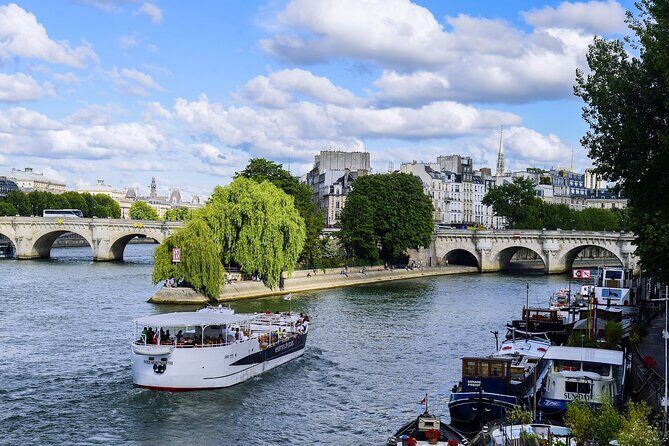
This section is the emotional high point for many people, because the river gives Notre-Dame a steady, centered feeling. You pass the Latin Quarter area via Pont Saint-Michel, built at the request of Napoleon III (you’ll notice the imperial N letters on its pillars). From there, the route reaches Île de la Cité, commonly considered the birthplace of Paris, settled by the Parisii tribe centuries before the Common Era (the island was called Lutetia).
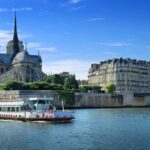
Then comes Notre-Dame Cathedral. Construction began in 1163 and finished nearly two centuries later in 1345. From the water, the cathedral’s mass and detail stand out, including gargoyles and sculptures.
If you’re the kind of person who likes to know what to look for, listen closely for the note about the Rose du Midi window on the south side. It’s dedicated to the New Testament and was described as a gift from Saint Louis.
Near this stretch, you’ll also see Saint Genevieve, patron saint of Paris. The statue is notable because it’s sculpted with her back to you, made by Paul Landowski—the same sculptor later associated with Christ the Redeemer.
Other boat tours in Paris
Île Saint-Louis and the Arab World Institute: quieter Paris along the water
After Notre-Dame, the river starts to show you another kind of Paris: slower, more residential, and still very iconic.
Arab World Institute
You pass the Arab World Institute, inaugurated in 1987 by President François Mitterrand. The cultural center focuses on history, art, society, religions, and science connected to the Arab world. From the river, it reads like modern culture inserted into an older city layout.
Île Saint-Louis: 17th-century streetscape
Then there’s Île Saint-Louis, known for prestigious 17th-century townhouse lines, including the Hotel Lambert and Hotel Lauzun. This is one of those areas that feels more “local” because it’s not just a sight you stop for—it’s a neighborhood vibe. The info you’ll hear includes names of famous residents like Charles Baudelaire and Georges Moustaki.
Hotel de Ville, the Conciergerie, and the Louvre’s full scale
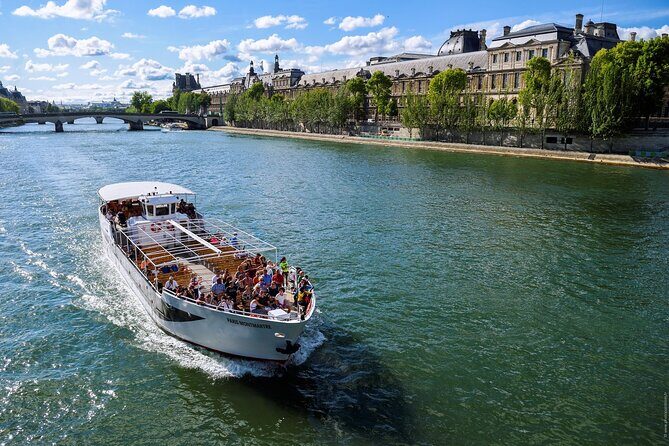
As you slide further along, the cruise moves into civic Paris and museum Paris—two categories that often feel separate on foot.
You pass Hotel de Ville, the Paris City Council seat since 1357. Construction takes inspiration from Neo-Renaissance style. There’s also a strong visitor connection: the banquet hall is designed to resemble the Hall of Mirrors in Versailles.
Next is the Conciergerie, built under Philip IV in the 14th century (nicknamed “the Fair”), then turned into a prison. It’s especially linked to the final period of Marie-Antoinette, who spent her last two months there before being executed at Place de la Concorde in 1793.
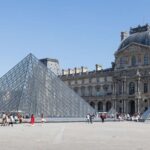
Then: the Louvre. From the river, it isn’t just a building—it’s the scale of the whole complex. It used to be a royal palace, became a museum in 1793, and it’s described as the largest monument in Paris with over four kilometres of façades and nearly 14 kilometres of galleries. The cruise narration highlights major works like the Winged Victory of Samothrace, the Venus de Milo, and the Mona Lisa.
Place de la Concorde, Grand Palais, and the American Flame
This part of the ride brings big architecture and revolutionary memory into the same frame.
Place de la Concorde
The Place de la Concorde is tied to the French Revolution executions of King Louis XVI and Queen Marie-Antoinette. In the center stands an obelisk originally from Luxor in Egypt, said to be 34 centuries old and brought to France in 1836.
Grand Palais
Next is the Grand Palais, built for the 1900 Universal Exhibition. You’ll hear it described as an architectural feat with a glass roof noted as the largest in Europe. Today, it’s used for events and exhibitions, and it’s listed as including one of Europe’s biggest skating rink setups.
Flame of Liberty
Then comes something fun and symbolic: the Flame of Liberty, an American gift created in thanks for restoring the Statue of Liberty. It’s described as an exact reproduction of the flame from New York.
Palais de Chaillot and Trocadéro views: a strong ending
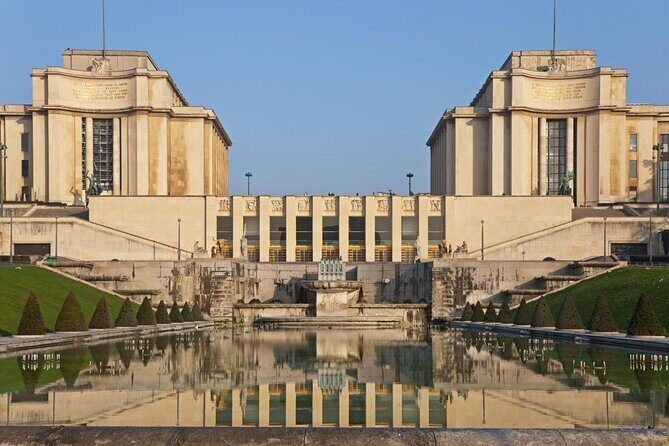
On the far end of the cruise, you finish near Palais de Chaillot, located at place du Trocadéro. The palace was built in 1937 for the Universal Exhibition and features two Neoclassical pavilions flanking an esplanade overlooking the Trocadéro gardens.
Inside, the narration points out the range of institutions associated with the building, including the City of Architecture and Heritage, the National Navy Museum, the Museum of Humankind, and the National Theatre of Chaillot.
This ending matters because it sets you up for your next step. If you’re continuing your sightseeing, you’re dropping off in a zone that’s already built for viewpoints and museum hopping—so you can keep the momentum instead of feeling like you’re stranded across town.
Timing tips: how to choose daytime or evening for the best photos
This cruise works in daylight and at night, but you’ll feel the difference in what you’re trying to capture.
In daytime, you see details: bridge ornaments, cathedral mass, and the shapes of the Louvre and civic buildings. The downside is that strong midday sun can flatten some architectural textures, and you may want time indoors if the weather is cool.
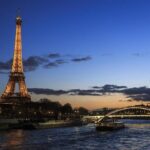
For evening, the pitch is simple: you’re closer to the City of Lights feeling, and people often time their plans around landmark lighting moments. One practical tip that showed up clearly in real schedules: taking a cruise around 4:45 pm can align nicely with watching the Eiffel Tower lights turn on around 6pm right as you finish your river run.
If you’re planning an evening outing, dress for the outdoor deck even if you think you won’t use it. You’ll want to step out for a few bridge and skyline frames.
Small practical gotchas: hearing the guide and using the restroom
A river cruise is easy, but it’s not always perfect. Here are the real-world issues that can affect your comfort.
Hearing the narration
The commentary can be harder to hear on the outdoor upper deck, especially when it’s windy or cold. If you find you can’t pick up what the guide is saying, switch positions. Sit where you can hear clearly, or use the phone app commentary if you prefer.
Also note that some guides may deliver the narration in both English and French, which can be smooth for bilingual listeners but confusing if you’re focused on only one language. If you’re sensitive to that, pick seating closest to the guide and keep your ears open for the English sections.
Restrooms
Onboard, toilets are described as free to use. But there’s a common confusion: the dock toilets are managed by another company and require either a receipt from the café or payment for public use. If you’re concerned about this, plan to use the onboard restroom first rather than waiting until you’re off the boat.
Safety briefing
You won’t necessarily get a long lecture. Life jackets are located on board, and the standard expectation is that the crew can dock safely if needed.
Who should book this Seine cruise (and who might pass)
This one-hour cruise is ideal if you want a low-effort way to get oriented. It’s also a good choice if you’re moving through Paris at a pace where you need time for museums and walking but still want the river landmarks in the mix.
You’ll likely enjoy it most if:
- You want to see major sites like Notre-Dame, the Louvre, and the Eiffel Tower from the water
- You want guided context without buying multiple separate tickets
- You like photo stops where the skyline frames naturally from the boat
You might think twice if you’re extremely picky about audio clarity. If you know you hate missing facts because you can’t hear the narration, plan to sit inside more often and keep the app ready.
Should you book the Seine River Guided Cruise by Vedettes de Paris?
My take: yes, if your goal is smart sightseeing with minimal planning. For around $25, you get an electric-boat ride, a real guide, and a route lined with landmarks that are hard to assemble in one walk.
Choose this especially if:
- You want the Seine as a first-day or reset activity
- You like the idea of learning while you look
- You can dress for cool outdoor deck moments
Skip it or treat it as a lighter experience if:
- You need very clear narration from the outdoor deck no matter the weather
- You’re traveling with a lot of luggage (since baggage isn’t accepted onboard)
If you want one simple “Paris greatest hits” solution that doesn’t steal half your day, this cruise fits the bill.
FAQ
How long is the Seine River Guided Cruise?
The cruise runs for about 1 hour.
Is the cruise narration available in English?
Yes. The experience is offered in English, and you’ll also hear live guide narration in English and French.
Is the boat electric?
Yes, the cruise uses a 100% electric boat.
Are snacks and drinks included in the ticket price?
Food and drinks are not included unless you select an option. If you choose the champagne option, it includes a glass of champagne. If you choose the Gourmand option, it includes a pancake or cookie with a soft drink. Snacks may also be available at the bar, but that depends on the option selected.
Where does the tour start?
It starts at 2 Port de Suffren, 75007 Paris (meeting point is listed as V75R+HJ7) and ends back at the same meeting point.
Are toilets free on board?
Onboard toilets are free to use. Toilets at the dock are managed by another company and require a receipt from the café or payment for public use.